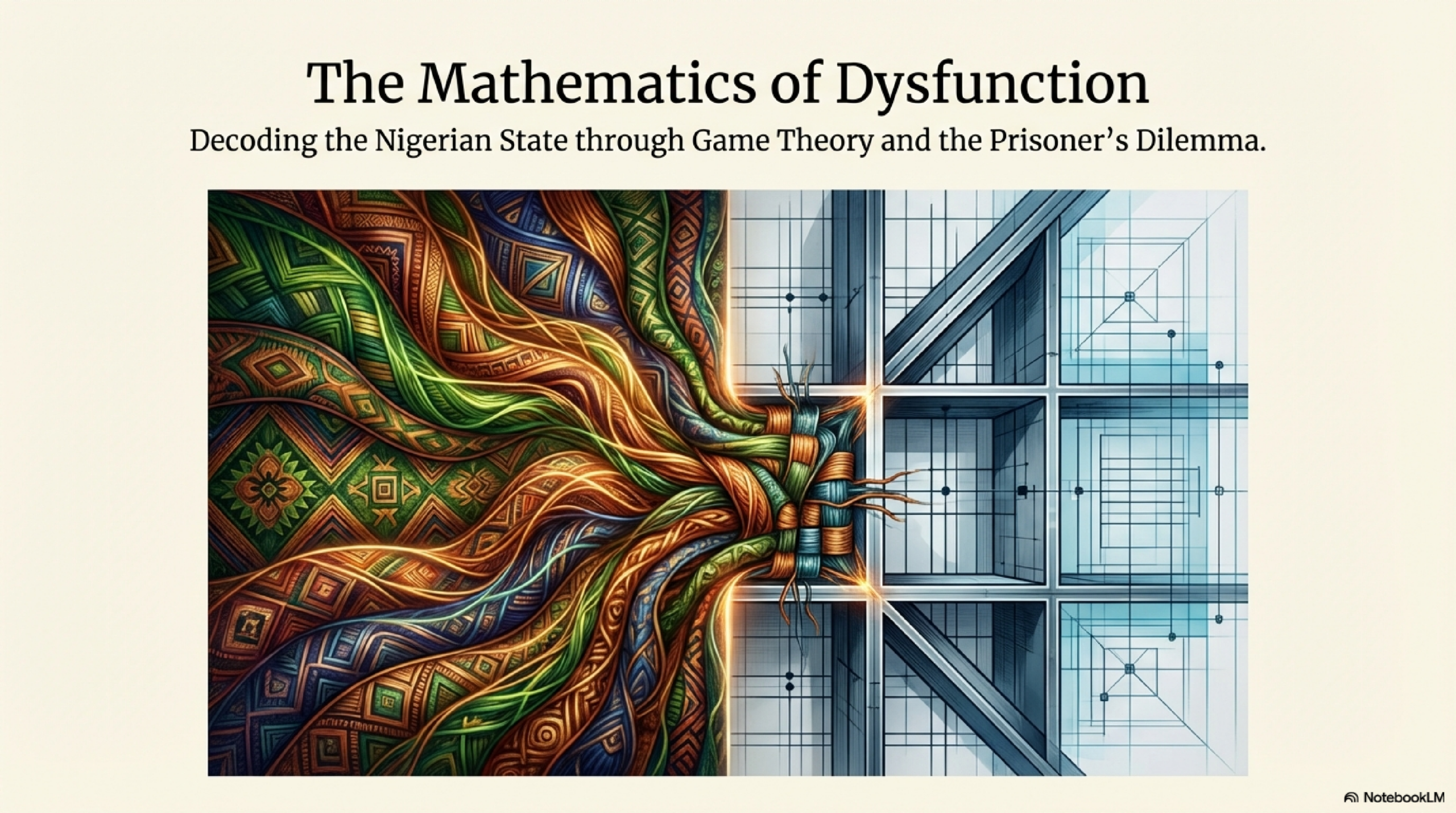
Prisoner's Delimma: A paradox in decision analysis, in which two individuals acting in their own best interest pursue a course of action that does not result in the ideal outcome for either.
Written by DiePreye Krukrubo (2013)

Nigeria, the most populous Country in Africa is about twice the size of California with over 150 million people, 250 ethnic groups, and over 500 different languages. The brilliance of its people is apparent in the number of Nigerians with world renowned achievements in music, literature, banking, finance, science and engineering. According to an article published a few years ago, Nigerians are the most highly educated immigrant group in the USA. The resilience of the Nigerian people is undisputable in light of our ability to adapt, assimilate and contribute to our new residential societies, when living in diaspora. Despite the infrastructural deficiencies and shortcomings of the Nigerian state, the innovation, high levels of energy and competitive productivity of its people has resulted in a GDP growth of about 6.5% since 2005, which is truly a testament our collective determination.
You’ve probably figured out by now that I draw a distinction between the Nigerian people and the state, and I limit the context of my examination to the situated instrument of the State (i.e. the institution charged with regulating, administering, and executing a “common good” for the people). I seek to explore the reasons why most Nigerians, most notably Dr. Ngozi Okonjo-Iwela- a former managing director of the World Bank, Finance Minister, and Foreign Affairs Minister of Nigeria- concludes that the Nigerian State is “…incompetent and inefficient.” I believe that an exploration and thorough understanding of the fundamental features of the ‘Nigerian’ legitimate discontent is a prerequisite for the successful reconstruction of the failing Nigerian state, and the reclamation of a creditable government by our people. I put it to you dear friends, that the failure of the state is the inevitable manifestation of the continual inter-ethnic apprehensions, and the aggressive pursuits of narrow interests.
The failures that everyday Nigerians live with include but are by no means limited to: ● Little to no electricity (sometimes for days on end).
- Interacting with “men in uniform” AKA law enforcement, who are empowered to serve and protect them, but at whose hands they are exploited and sometimes beaten.
- Little access to safe drinking water.
- Queuing in long lines for hours to get fuel despite living in one of the world’s top oil producers.
- Growing Islamic fundamentalism in the North, and armed insurrection by Southerners in conflict with foreign oil companies and the government for local resource control and social justice.
An atrocious state of education, a catastrophic rate of unemployment, abject poverty, armed robbers, ethnic killings, and rampant corruption!
Some people, unable to recognize the plethora of failures as the tragic yet logical consequences of “democratic” activities in Nigerian politics, buy into the notion that democracy is exclusively western and intrinsically “un-African,” with generic exclamations of how united Africans were before “…the white man came and divided us with western education and democracy”. They evoke the convoluted history of the transatlantic slave trade, with oversimplified revisions of African victimization, impressing upon the role of Europeans while conveniently neglecting the most definitive role of all.

I’ll start by addressing African victimization and the transatlantic slave trade. Yes, the transatlantic slave trade, driven by competition within major European empires for economic dominance through the industrial revolution (distinct from the industrial era), provided the free labor on whose backs Europe and the Americas were pushed to the forefront of modernity and scientific discovery, while creating enormous wealth and opportunity for their people and markets. Yet while much ado is made about the European utilization of African slaves to build the foundations of an industrial era, the far more significant (and least addressed issue) is the collective decision made by African men (of free will in sub-autonomous circumstances), to commoditize their richest capital, themselves, in narrow-minded calculations for the accumulation and/or preservation of wealth and territory. So much so in fact, that not only was the slave trade a domestic social and political reality, but slaves were the major export within what would be called Nigeria for over 100 years well into the 19th Century.
Sure, the need for slave labor created enormous wealth and opportunity for some of the trading empires within Nigeria, by developing alliances and avenues for the acquisition of superior western arms necessary for their preservation. However I propose that the current inter-ethnic distrust, which poisons the Nigerian body politic, is due in part to the pre-colonial Nigerian zeitgeist. The major empires in Nigeria were able to accumulate wealth, consolidate power and develop their societies through the exposure and trade of transatlantic goods. For example, the Fulani in the North, before being centralized with their capital in Sokoto in the 18th century, accumulated wealth by virtue of their control of the major trade route between the Northern region and Southern forest region. The Yoruba in the West gained control of the major Nigerian transatlantic harbor that would come to be known as Lagos Harbor, and a fierce military cavalry which ensured their expansion deeper into the tropical forests in the South during the 16th Century. These already existing divisions among various ethnic groups in Nigeria were exploited by the stronger empires in Nigeria to profit from the slave trade. For example the Ijaws were known for being the most influential “middlemen” between Europeans and regional slave markets in the 19th century.
At the turn of the 19th century, the biggest impact was the loss of, conservatively speaking, over 50 million strong and healthy African minds and bodies (about 4 million of whom came from Nigeria). Whatever contributions these men, women and children could have made, including those to literature, arts, fashion, poetry, domestic industry, medicine, politics, sports, science, economics, military innovation, intercontinental exploration, and in offspring, were lost. Additionally, the socio-political grip of slavery on the empires in Nigeria led to continuous slave raids by competing ethnic groups, which undermined the stability and longevity of most of the social, political and normative institutions of all of the tribes. The larger empires, corrupt and/or content with their narrow profits and innovations from the slave trade, were less incentivized to invest in their people and the institutions that would be necessary for the viability and development of any community in a new industrial era, thereby sowing the seeds of their own downfall.

This illuminates the true nature and outcome of colonialism, not as the cause of African or Nigeria’s disunity, but simply the catalytic exploitation of the manifested divisions amongst Nigerians even before the transatlantic slave trade. Consider the efficiency with which the colonial subjugation of Nigeria was achieved: The Royal Niger Company– a convergence of British trading enterprises and political interests, successfully subdued the western trading stronghold of Lagos in 1861; they gained control of the Delta region in 1893 (thereby becoming the Niger Coast Protectorate under British rule); The Niger Coast Protectorate then gained control of the Hausa capital (Sokoto) in 1906. In 1914, northern and southern Nigeria merged to become the colony and protectorate of Nigeria. Finally in 1922, after WWI, the Eastern part of Nigeria (initially under German rule) was split. On one side, the British administered the eastern territory of Nigeria; on the other, the French administered Cameroon. This is Nigeria: a mosaic of over 250 different ethnic factions and interests, over 500 languages with little cultural commonalities, all piled into an arbitrary demarcation.
And so western schools did not teach English to provide language to a people without the prerequisite agencies of faculty or discourse. English was simply the solution to the question of how to efficiently communicate broad directives of centralized expectations, to a population consisting of 250 ethnic groups and over 500 different languages. Laws and institutions were not made to generate, support or protect ‘a collective good’, but were often bargaining tools used among the major ethnic groups (for political sway). Christianity and civil courts were not a means of delivering salvation to millions of Nigerians existing without civilization; instead these institutions were a means of pacifying the plethora of diverse religious and socio-economic orientations that existed among over 250 ethnic groups in Nigeria- while streamlining their collective input for the benefit of the European capitalist-industrial complex.
Simultaneously, the northern parts of Nigeria were spared the full imposition of these new social and political infrastructures thrust upon the entire State. Why? …Because it was far more beneficial to operate through proxy leaders of an already existing and highly centralized State (long established since the time of Usman Dan Fodio). Ironically, this strategy- which afforded the northern political elite more autonomy than their southern counterparts (during colonization), ultimately led to the lack of important infrastructural investments and opportunities afforded to their southern counterparts. In order words, by rejecting ‘English’, they found themselves rejecting education and the investments necessary in creating the institutions of contemporary higher learning. By rejecting western science, they found themselves rejecting medicine and the necessary institutions of health and human service…and so on.
So while the only emergence of a “Nigerian identity” came in collective opposition to the political disposition that rendered the indigenous people of Nigeria unable to determine their own political affairs, while this new found identity emboldened a new generation of Nigerian elites and intellectual class to demand independence, the elemental pre-maturity on the supposition of a “United Nigeria” became apparent by independence day and continues to be so until today.
At the time however, the larger question of Nigeria’s independence revolved around those that sought to maintain pre-colonial autonomy and those who derived better prospects for the sustainability of their interests, in a centralized federation. Neither, however, could afford to lose out on the wealth of natural resources discovered in the region, and to which they would lose claim by a decision to disintegrate.
Backward Induction: Backward induction is an iterative process for solving finite sequential fixtures. First, one determines the optimal strategy of the player who makes the last move of the game. Then, the optimal action of the next-to-last moving player is determined taking the last player’s action as given. The process continues in this way backwards in time until all players’ actions have been determined.

In an attempt to cuddle various factions, the centralized federation- constructed to encompass the interests of all ethnic groups- consequentially paid little attention to creating structures necessary for empowering and efficiently fulfilling the basic obligations to which state and local governments are best suited (by virtue of their proximity to the people).
Consider that in all 36 States of the Nigerian federation, electric and gas supply, urban planning, and even the police force are all constitutional functions of the federal government. In addition, the federation, intended to have a proactive executive branch that could rise above the fray of partisanship, ceded almost unlimited power to the executive branch, not least important of which is the appointment of Supreme Court judges without confirmation from the legislative branch. The federal government solely controls all natural resources in Nigeria, controls the processes of granting mining contracts, and the allocation of revenues to the states, while leaving the people in the states burdened with pollution and other aftermaths of industrial exploitation.
The federal government is solely responsible for the funding and allocation of fiscal investments, from education to land apportionment. On the legislative front, the multiparty system and majority elections are touted as the “democratic vibrancy of Nigeria”… In reality, the multiparty system has discouraged the minimal discourse necessary in constructing a language of “common good”, while transforming long existing and entrenched narrowed interests into political parties. National elections by majority therefore become fodder for enormous corruption, unscrupulous deal-makings, and ethnic violence among the people associated with one party or the other.
And so, by monopolizing national, state and local obligations and responsibility, the federal government has become in essence the grand prize of ethnic and commercial interests, and has been rendered the inefficient and incompetent institution we infamously term “The Nigerian Government”.


I digress a bit to highlight the repulsive and dangerous agreement which shares executive authority among the four major regions (headed by Hausas, Yorubas, Igbos, and Ijaws) to literally take turns with, like a whore waiting to be used every term.
At the beginning of our latest Republic, Olusegun Obansenjo (a westerner) was “elected” president with a general understanding that it would be a Northerner’s (Hausa) turn next. And indeed, in a country of 150 million people, 250 ethnic groups and 500 different languages, of all the Presidential Candidates, the top three (by huge margins) were all Northerners (again with the expectation of a Southerner being next in line). Before his death, with the ailing of the previous President Umaru Mus Yar’Adua and his year-long medical hiatus from the country, and with demands for a Southerner successor, the evidence of the weakness of such a foolish arrangement laid obvious in our political gridlock, while our people fell victim to, and acted out delusional passions meticulously constructed once again by leaders with their own narrow interests.
Many of us in the Diaspora, disillusioned by the succubus of our reality and the plight of our loved ones back home, existing in a sort of metaphysical juxtaposition between the traumatic effects of our collective disposition and keeping up with an unfamiliar and ever changing global society… many of us resolve inward while concluding in favor of a proposition for the Nigerian State, as hopeless. Many Nigerians argue that the problems of Nigeria are too great, and so, we must redirect our focus on things we have control over (most important of all, the welfare of our families).
I greatly empathize with this view- Nigerians are exhausted. But there is no precedent in history for any problems dissolved by virtue of a de-recognition of the problem; as there is no precedent for roads building themselves; nor science and commerce somehow developing out of thin air, nor reconciliation or peace achieved in resignation of individual talent and input. And so I humbly offer my input. It seems to me that the only guarantee left after disengagement, is the inheritance of the status quo unto the next generation. Alas, the claim of individual disengagement, while an understandable conclusion by reasonable yet admittedly exhausted people, is only reactionary and falls far short of tackling the symptoms of the collective Nigerian discontent as we know it.
Others argue that as the Government is the problem, the Private sector is the solution. Ngozi Okonjo-Iwela explained the reforms that took place in her tenure in the Nigerian government, including the liberalization of markets, the de-linking of the federal budget to oil revenues and the beginning withdrawal of the State from the private sectors. She highlighted the results- including over a billion dollars in annual telecom investment, and a federal budget saving of over 27 billion dollars- as a testament to the efficiency of the private sector.
To be clear, we offer no opposition to the notion that a free market is the most efficient mechanism for the accumulation of wealth both individually and collectively. Nor is there a sense that the government, with finite resources and complex priorities to confront, should be meddling in the private sector instead of figuring out ways of investing in the public infrastructure and allocating a collective benefit amongst the people.
However, we need not look far into the histories of commercial Republics that existed before the founding of the United States or even the British Empire, to realize the dangers of an over-reliance on the private sector for the allocation of the public good. We need only look inward to Nigeria where there exists a tale of two realities. One home, huge, with broken bottles and spiked fences, guard dogs and armed security guards, drivers and maids, power generators for constant electricity and private water supply; the other home, a shack with no address, only six hours of electricity, no running water- chances are, with no college education and no job, no police protection, etc.; and these two homes stand side by side on the same street, in the same neighborhood, in the same city in Nigeria. History has shown that without the basic introspection in devising mechanisms for manifesting a collective benefit through a just
government, even in the existence of commercial vibrancy- as inequality gaps widen, social unrests are inevitable. Time and time again, we have allowed our momentary passions and immediate interests to actively control our collective conduct over remote considerations of policy, utility and justice. We have allowed aversions, predilections and rival-ships of narrow interests to affect our common good. And far too often, we have allowed our people to succumb to the rage and jealousy that destroy communities and make the differences in conceptions of National identity irreconcilable.
Again, we need only look inward into the devastating manifestation of our own civil war for proof of our self destruction:
A coup d’état naïvely conducted under a precept of cleansing across the board the corrupt political zeitgeist – but that instead left assassinated, the highly revered Sultan of Sokoto from northern Nigeria, the Prime Minister (also from northern Nigeria), and his host, a Governor from the west… while sparing Igbo (eastern Nigeria) government officials. Surely such a coup was understandably unforgivable from a northern perspective. The consequent massacre of hundreds of thousands of Igbos in the north, as well as the exodus of even more Igbos from the North was evidence also of an understandable, destructive and irreconcilable outcome from an eastern perspective… and so, we went to war.


My fellow Nigerians,
We must use the testimony of experience to guide our judgments, and that begins with the collective acceptance of the checkered circumstances of our being. We must resolve to a worthy and encompassing national identity expressed solely in reclamation of a Nigerian Government for all the Nigerian people.
It would be over-presumptuous of me to delve into one logistical suggestion or the other, as such complicated matters as I have eluded, require the input of men far more learner’d and certainly more powerful than I am.
However I do believe that the Nigerian Diaspora and social elite have a very important role in expediting the economic progress already taking place, influencing the domestic political language and constructing highly competitive incentives for democratization and the rule of law in the Nigerian political framework. But that’s another matter.
DiePreye A. Krukrubo