The unraveling of Nigerian politics over the past decades has left citizens disillusioned with a system that perpetuates failure. At the heart of this story is the Labour Party—a political platform that once represented hope but has since become emblematic of the deeper structural flaws undermining governance across the nation. What is happening within the Labour Party today is not an isolated crisis. It reflects a broader malaise affecting Nigerian politics, where constitutions are tools for consolidating power rather than empowering the people.

Central to the Labour Party’s recent failures is its constitution, a deeply flawed document that consolidates power in the hands of one individual: the National Chairman. The chairman wields unchecked authority as the head of both the National Executive Committee (NEC) and the National Working Committee (NWC). These roles, which should act as checks on each other, instead become tools for reinforcing autocracy. This structural flaw has enabled a culture of impunity that not only destabilized the party but also stymied its ability to function as a credible political alternative.

Peter Obi’s emergence as the Labour Party’s presidential candidate was, in many ways, a turning point for the party. It reinvigorated its image and galvanized the Obidient Movement, which quickly became a powerful political force, drawing millions of Nigerians into its fold. However, Obi’s ascent to the Labour Party ticket was not without compromise. Behind the scenes, a tacit agreement was struck between Obi and the party’s leadership, including Julius Abure, the National Chairman.
The terms of this agreement were clear: Obi would receive the party’s presidential ticket, but in exchange, he and the Obidient Movement would stay out of the Labour Party’s internal affairs. This meant turning a blind eye to the undemocratic processes that had allowed Abure to consolidate power. It also meant refraining from addressing the grievances of other factions within the party, many of whom felt sidelined and betrayed.
This unholy alliance served as a temporary truce, allowing Obi to focus on the presidential election without being dragged into the party’s internal conflicts. However, it came at a cost. By staying silent on the Labour Party’s structural issues, Obi and the Obidient Movement inadvertently legitimized Abure’s undemocratic practices. They allowed the flawed constitution to remain unchallenged, setting the stage for the factionalization and chaos that would erupt after the election.
When the elections ended, and the party’s internal wrangling reached a boiling point, the Obidient Movement found itself at a crossroads. Having avoided confrontation for so long, they now faced a fragmented party, with multiple factions accusing one another of constitutional violations. But the root of the problem was not any one faction—it was the constitution itself.
A Broken Constitution and the Fall of the Labour Party
Julius Abure’s tenure as chairman epitomizes the dangers of centralized power. After his term officially ended, Abure refused to step down. Instead, he organized a sham convention where he handpicked state executives without elections or input from stakeholders. This brazen act of impunity exposed the party’s structural flaws, demonstrating how its constitution allowed one individual to dictate its direction without accountability.
The NEC and NWC, which should have served as checks on the chairman’s power, were rendered impotent by the constitution’s design. With no mechanism to challenge Abure’s decisions effectively, the party descended into chaos. Factions turned on each other, accusing rivals of violating the same constitution that had failed to protect them.
This constitutional failure mirrored the dysfunction seen in Nigeria’s broader political system, where the PDP and APC dominate through patronage, corruption, and self-interest. These two parties have long competed for a shrinking pool of voters—only 15 to 20 percent of registered voters participate in elections, leaving the remaining 80 percent disillusioned and disengaged.
For the Labour Party to survive, and for Nigerian politics to be revitalized, a new approach is needed—one that breaks decisively from the failures of the past and offers a credible, inclusive alternative to the PDP and APC.

Realizing a New Political Coalition
The formation of a new political coalition begins with an act of symbolic and substantive unity. All participating smaller parties must agree to collapse into the smallest registered political party, relinquishing their individual identities to create a singular, unified platform. This decision is not just symbolic—it is a deliberate rejection of ego and a demonstration of collective purpose. By rallying under the smallest party, the coalition signals to Nigerians that this movement is about the people, not individual ambitions or entrenched interests.

Once unified, the coalition will embark on drafting a new constitution—one that prioritizes transparency, accountability, and fairness. This constitution will address the structural failures of the Labour Party and other traditional political systems, ensuring that power is distributed and democracy is upheld at every level. The drafting process will be inclusive, incorporating input from grassroots organizations, civic leaders, and ordinary Nigerians to reflect the needs and aspirations of the people.

To solidify its legitimacy and showcase its commitment to democracy, the coalition will organize a referendum, inviting all party members and supporters to vote on the new constitution. This referendum will not only ratify the party’s foundational principles but also demonstrate to the public how the coalition intends to govern—with openness, accountability, and a focus on collective decision-making.
The Structure of the New Party
The new party will be built on the principle of separation of powers, ensuring that no single individual or group can dominate its processes. Its structure will include three key branches:
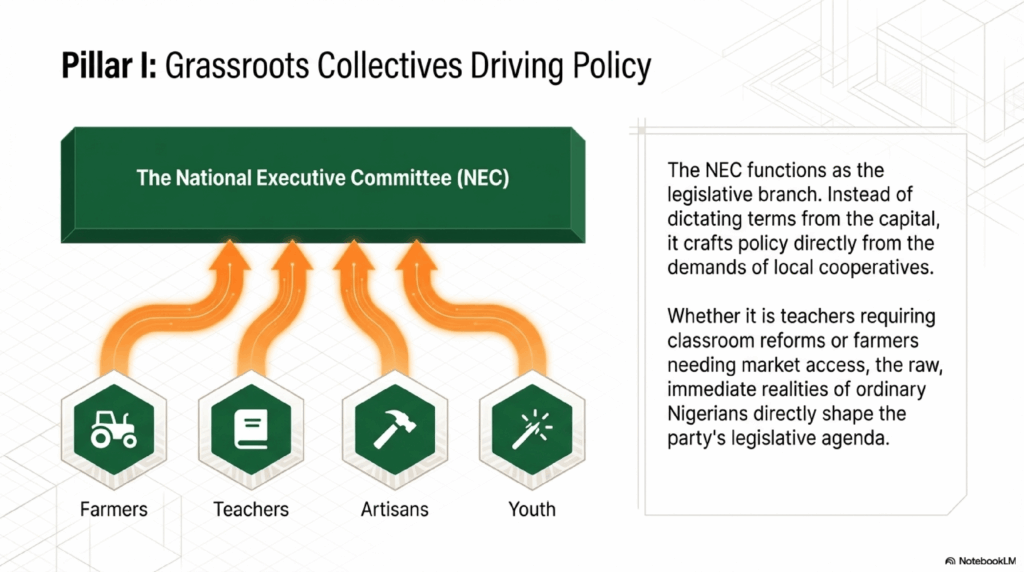
The National Executive Committee (NEC): The Legislature
The NEC will serve as the legislative branch, responsible for crafting the party’s policies and resolutions. Its primary focus will be on building grassroots collectives and cooperatives across the country. These groups—whether representing farmers, teachers, youth, or artisans—will ensure that the needs and demands of ordinary Nigerians flow directly into the party’s agenda. By organizing local communities into active collectives, the NEC will create a bottom-up structure where party policies and priorities are shaped directly by the people.
For example, a collective of teachers might propose education reforms that directly address the gaps they experience in classrooms. Farmers, facing challenges with access to markets or modern equipment, could push for policies that solve their specific needs. These grassroots-driven resolutions would then feed directly into the NEC’s legislative process, ensuring that the party’s direction reflects the realities of those it serves.
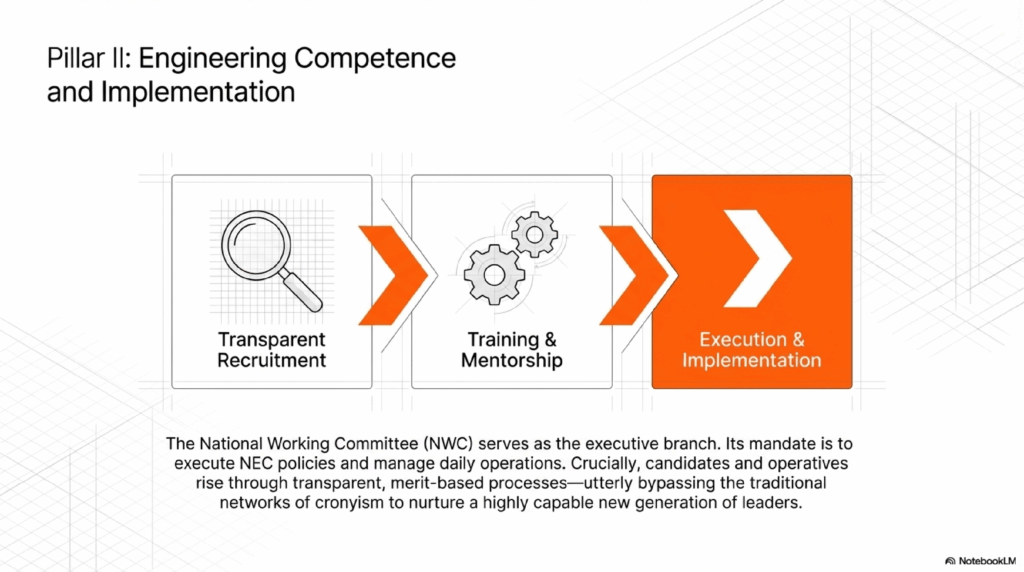
The National Working Committee (NWC): The Executive
The NWC will function as the executive branch, tasked with implementing the policies set by the NEC and managing the party’s day-to-day operations. Its responsibilities will include recruiting and supporting candidates who genuinely represent the people’s will. These candidates will not rise through patronage or personal connections but through a transparent, merit-based process.
The NWC’s mission is not just to identify and support candidates but to create an institutional framework that nurtures a new generation of leaders. By providing resources, training, and mentorship, the NWC ensures that these leaders are prepared to serve with integrity and competence. It will also oversee the development of the party’s infrastructure, ensuring that every local and state office has the resources needed to thrive.
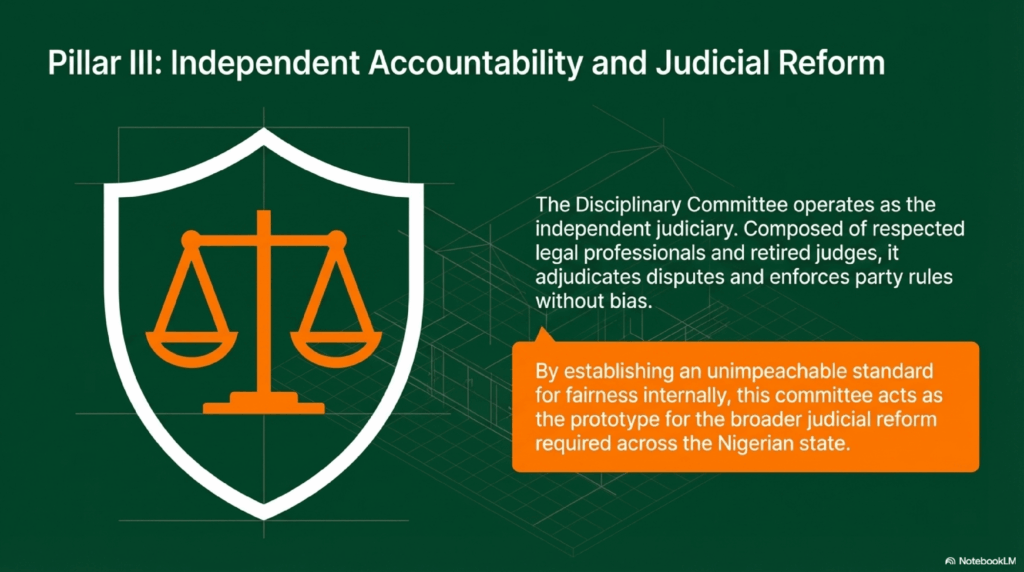
The Disciplinary Committee: The Judiciary
The Disciplinary Committee will serve as an independent judiciary, ensuring accountability and adherence to the party’s principles. Composed of respected legal professionals, including retired judges, this committee will adjudicate disputes, interpret the constitution, and enforce party rules. Its decisions, submitted to the NEC for final approval, will safeguard fairness and transparency within the party.
Beyond its internal role, the committee will lay the groundwork for broader judicial reform in Nigeria. By setting a high standard for fairness, transparency, and accountability, the Disciplinary Committee can help reshape the way justice is administered, fostering a new generation of legal professionals committed to equity and the rule of law.
This structure—the NEC as the legislative branch, the NWC as the executive branch, and the Disciplinary Committee as the judiciary—ensures that power is distributed and that the party remains accountable to its members at every level.
Addressing the Skeptics
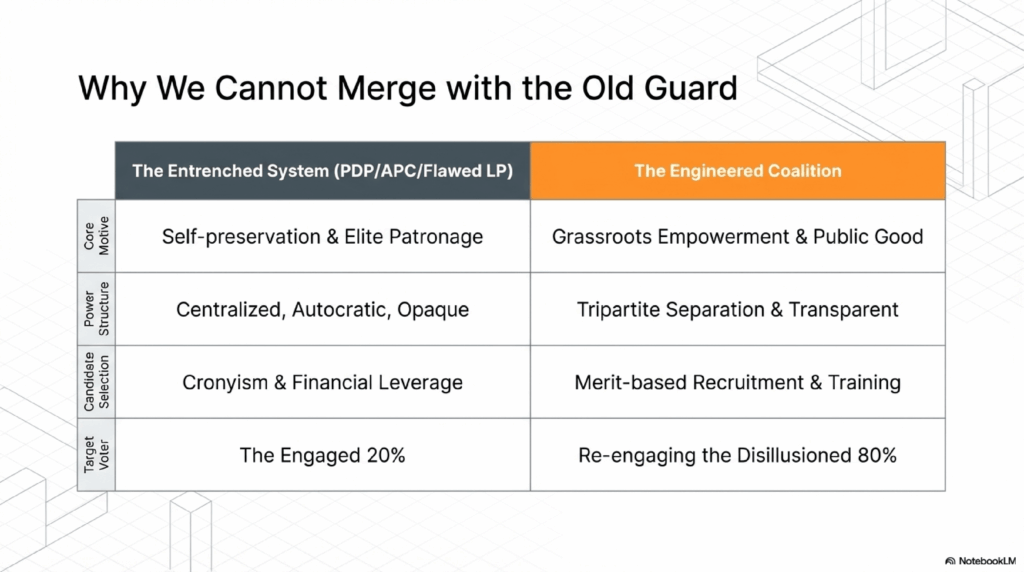
Critics might argue that forming a coalition of smaller parties cannot compete with the entrenched power of the PDP and APC. They may also ask: Why not join forces with the PDP or APC to create a unified opposition? On the surface, this might appear to be a practical solution. After all, the PDP boasts 13 governors, an expansive network, and significant political machinery. But merging with these entrenched parties would come at the expense of the coalition’s integrity and vision.
The PDP and APC are emblematic of the systemic problems in Nigerian politics. These parties prioritize patronage, self-preservation, and the narrow interests of their elite members over the needs of the Nigerian people. Joining them would dilute the coalition’s purpose and align it with the very forces that have failed the nation. Furthermore, governors and political leaders within the PDP and APC have no genuine interest in empowering an opposition coalition. Their support would likely be conditional, serving only to maintain their grip on power and control over state resources.
This coalition’s mission is not to work within a corrupt system but to challenge and replace it. By creating a party that operates on the principles of transparency, accountability, and grassroots empowerment, the coalition can distinguish itself from the PDP and APC and offer Nigerians a genuine alternative. The goal is not to perpetuate the old system but to build something entirely new.
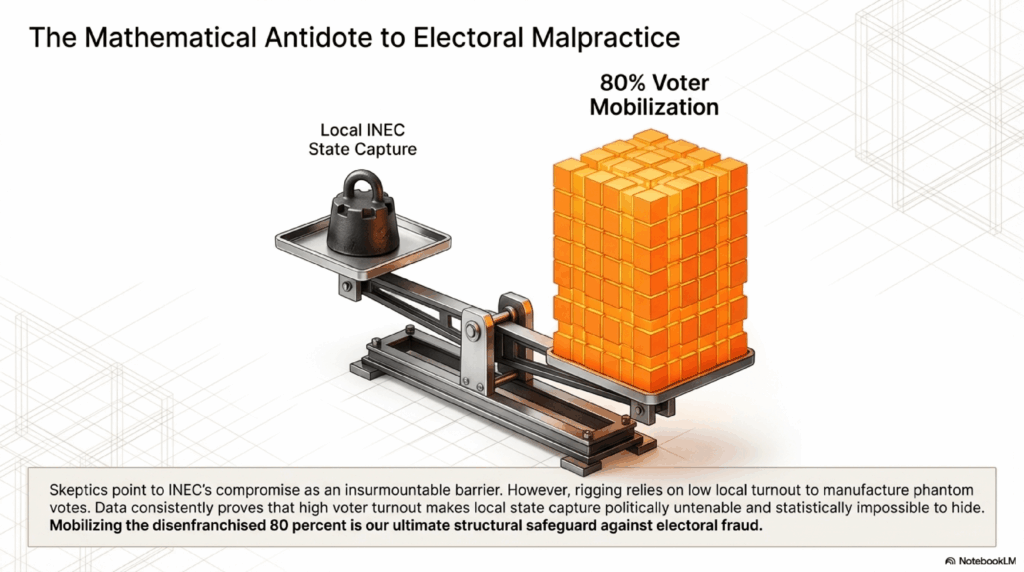
Additionally, skeptics may point to the Independent National Electoral Commission (INEC) and claim that it is too deeply compromised by state capture to allow opposition parties to win or have their victories certified. While these concerns are valid, they overlook an essential truth: high voter turnout reduces the likelihood of electoral manipulation.
In areas where voter turnout is low, there is greater room for rigging at the local government level, where elections are most vulnerable. However, data consistently shows that high turnout correlates with reduced instances of electoral fraud. When large numbers of voters show up, it becomes significantly harder for INEC or any compromised entity to certify blatantly fraudulent results. Mobilizing the 80 percent of disillusioned voters is not just a strategy for winning elections—it is a safeguard against electoral malpractice.
This coalition’s mission is to re-engage these voters, giving them a reason to believe in the political process again. By focusing on transparency, grassroots empowerment, and democratic governance, the coalition can generate the kind of voter turnout that makes rigging not only difficult but politically untenable.
Some might also question whether the coalition can overcome internal divisions or power struggles. But the symbolic acts of collapsing into the smallest party and ratifying the new constitution through a referendum create a foundation of unity and shared purpose. These steps demonstrate that this coalition is not about maintaining the status quo but about building something entirely new—something that prioritizes the people over personal ambition.
A Legacy for the Future
For leaders like Peter Obi, this coalition represents more than just a political opportunity—it is a chance to create a lasting legacy. The coalition provides a platform to move beyond the compromises of the past, such as the unholy alliance that silenced meaningful critiques of the Labour Party’s internal failings. It offers an opportunity to lead a movement that isn’t bound by the old rules or beholden to entrenched interests.