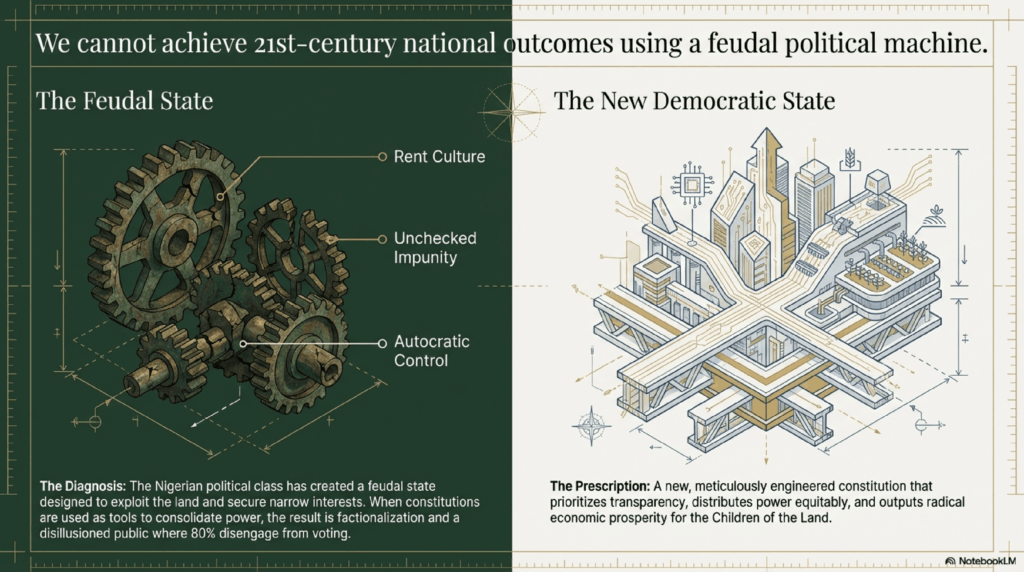
The Nigerian political landscape is no longer merely failing; it has devolved into what the “Children of the Land” text describes as a “feudal state” characterized by “utter ineptitude and malice.” For decades, a narrow political class—unworthy of the privilege of leading—has treated the nation’s resources as a private treasury, institutionalizing a “rent culture” that leaves the citizenry in destitution. With roughly 80% of registered voters choosing to disengage from this “culture of corruption and cronyism,” the system faces a crisis of legitimacy that cannot be solved by incrementalism.
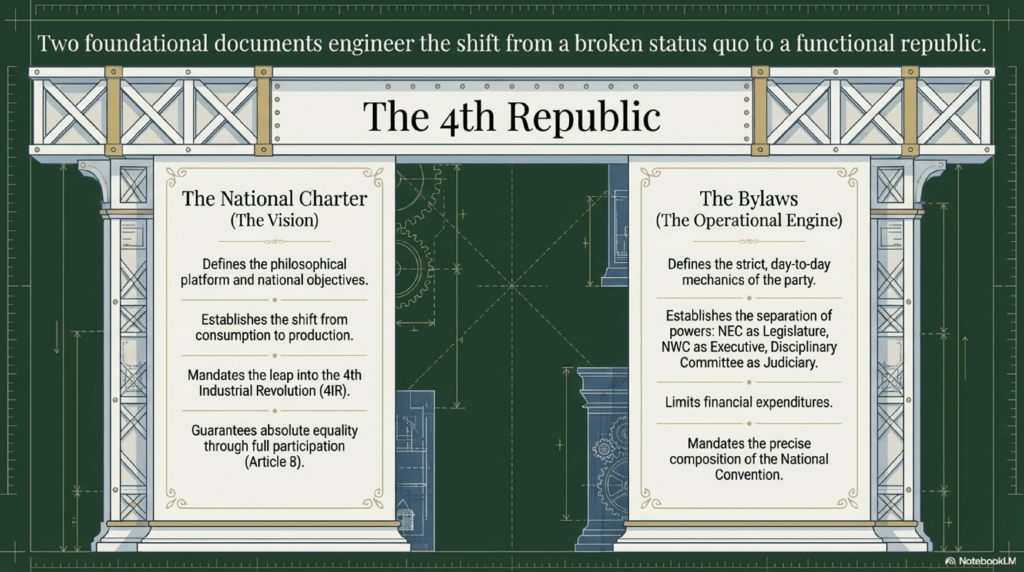
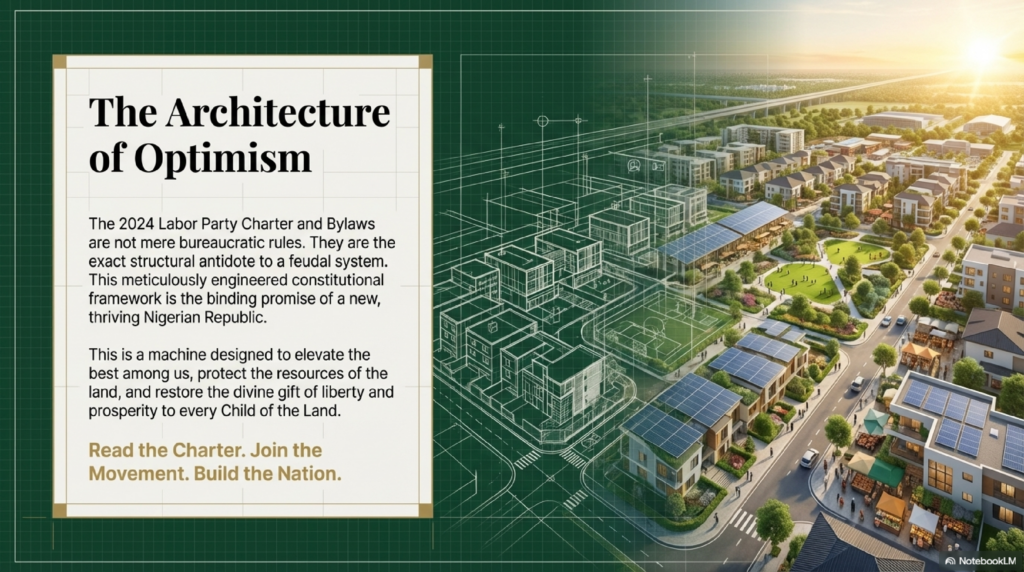
The Draft 2024 Labor Party Bylaws and Charter proposals, authored by DP Krukrubo, represent a technical rescue operation. This is not a mere campaign manifesto; it is a structural roadmap designed to dismantle the “shackles of existing political structures” and replace them with a representative system built on accountability, merit, and the “sacred duty” of serving the public good.
Killing the "National Chairman" Autocracy
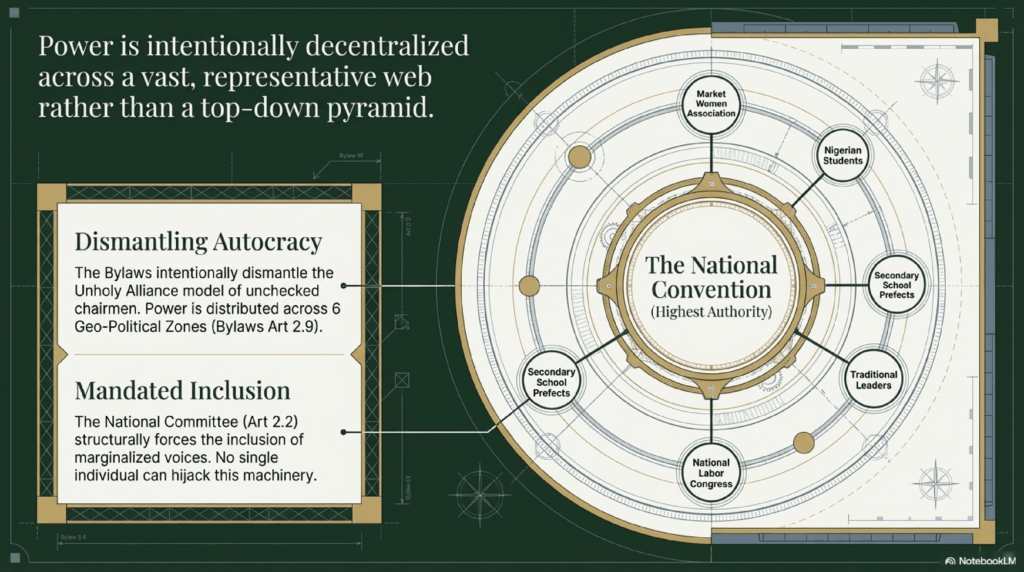
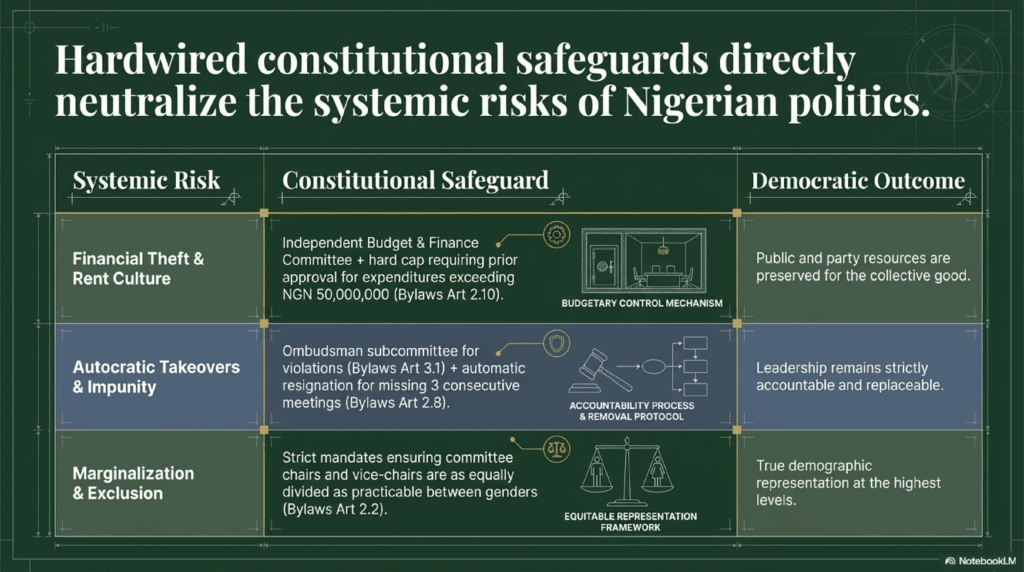
A central cause of Nigeria’s democratic decay is the “unholy alliance” often struck between popular candidates and party leadership. As seen in recent political history, truces are frequently made where candidates receive tickets in exchange for ignoring the “unchecked authority” of a National Chairman. This consolidation of power allows a single individual to head both the National Executive Committee (NEC) and the National Working Committee (NWC), rendering internal checks and balances impotent.
To end this cycle of impunity, the 2024 proposals institutionalize a three-branch party architecture designed to make such truces impossible through structural design:
- The NEC (Legislative/Grassroots): The highest policy-making body, responsible for resolutions and legislative oversight.
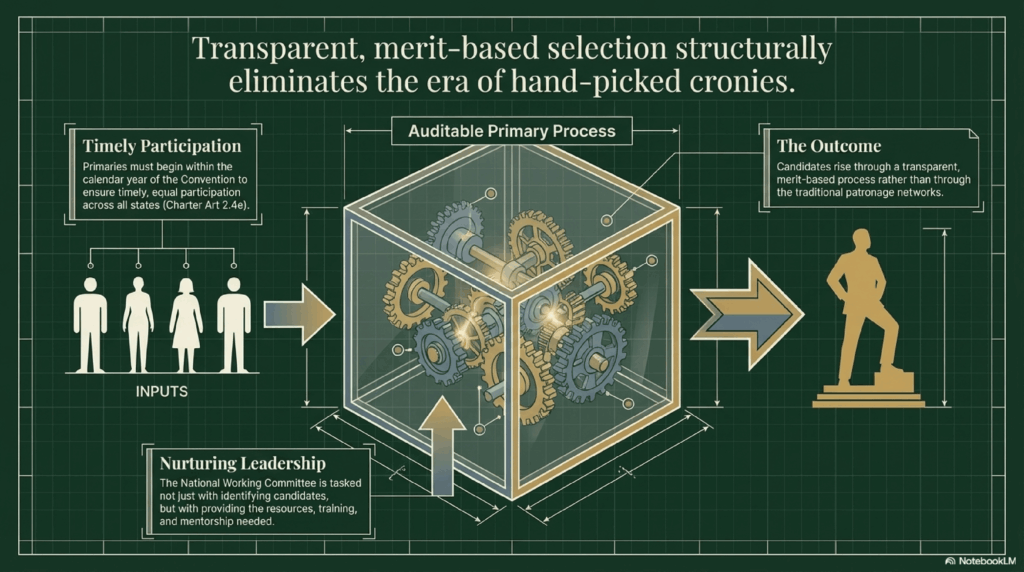
- The NWC (Executive/Operational): Tasked with day-to-day implementation and merit-based candidate recruitment.
- The Disciplinary Committee (Judiciary): An independent arbiter for disputes and constitutional interpretation.
“What is happening within the Labour Party today… reflects a broader malaise affecting Nigerian politics, where constitutions are tools for consolidating power rather than empowering the people.”
By strictly separating these powers, the 2024 framework ensures that no individual can dictate the party’s direction. This internal separation is a necessary precursor to ending the “rent culture” that plagues the national government.
Bottom-Up Governance via Grassroots Collectives
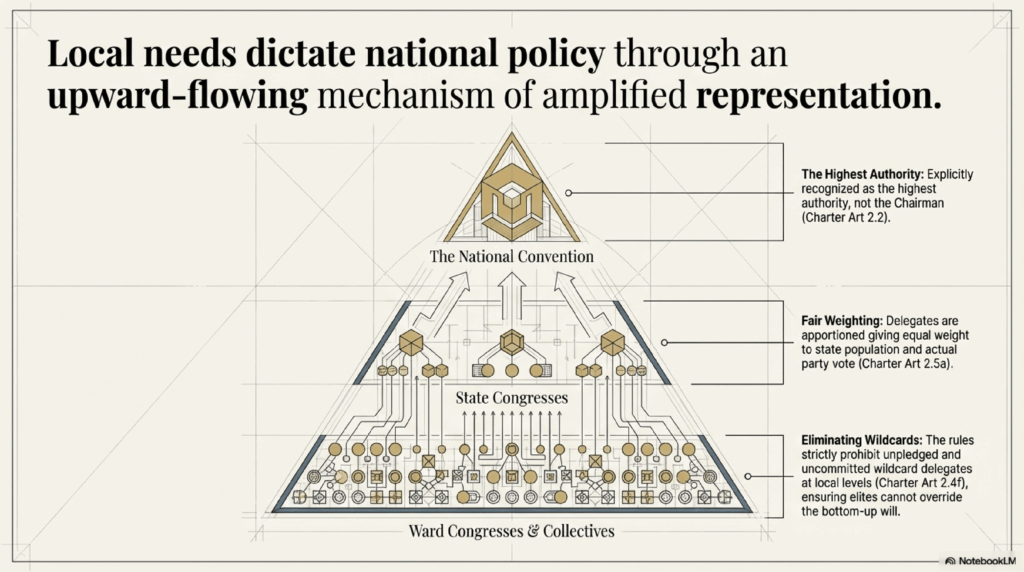
The new structure effectively removes the “middleman” of the political elite by institutionalizing grassroots collectives. According to Article Two of the Bylaws, the NEC is mandated to organize society into active collectives of farmers, teachers, artisans, and youth.
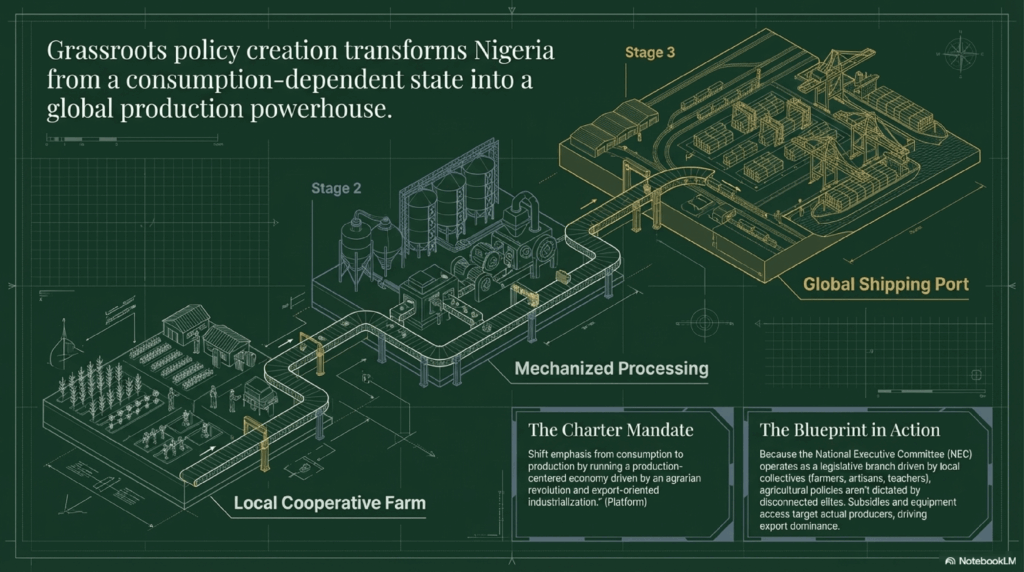
Unlike traditional “wings” of a party, these collectives possess a direct policy mandate. For example, a “collective of teachers” does not just support the party; it identifies specific classroom gaps and feeds those resolutions directly into the NEC’s legislative process. This ensures that the party’s platform is not a product of elite patronage but a reflection of the realities of those who perform the nation’s labor. By making the NEC’s policy agenda dependent on these bottom-up inputs, the 2024 proposals ensure that public services are designed to tackle real-world problems rather than serve the interests of “thugs and mercenaries.”
The Economic Leapfrog: 4IR and Agrarian Revolution
The National Labor Party Charter shifts the national economic paradigm from “consumption to production.” This transition is powered by what the Charter calls “entrepreneurial public sector governance”—a model where the state acts as a catalyst for growth rather than a drain on resources.
The economic strategy focuses on two pillars:
- Export-Oriented Industrialization: Leveraging Nigeria’s land and natural resources through an “agrarian revolution” to move beyond raw material exports.
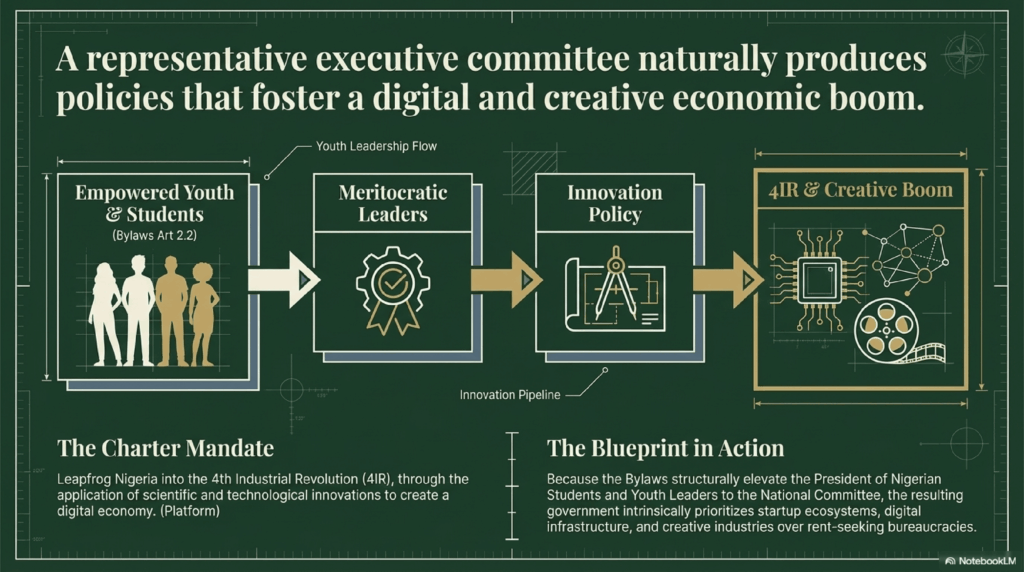
- The 4th Industrial Revolution (4IR): Applying scientific and technological innovations to “leapfrog” traditional development stages and build a competitive digital economy.
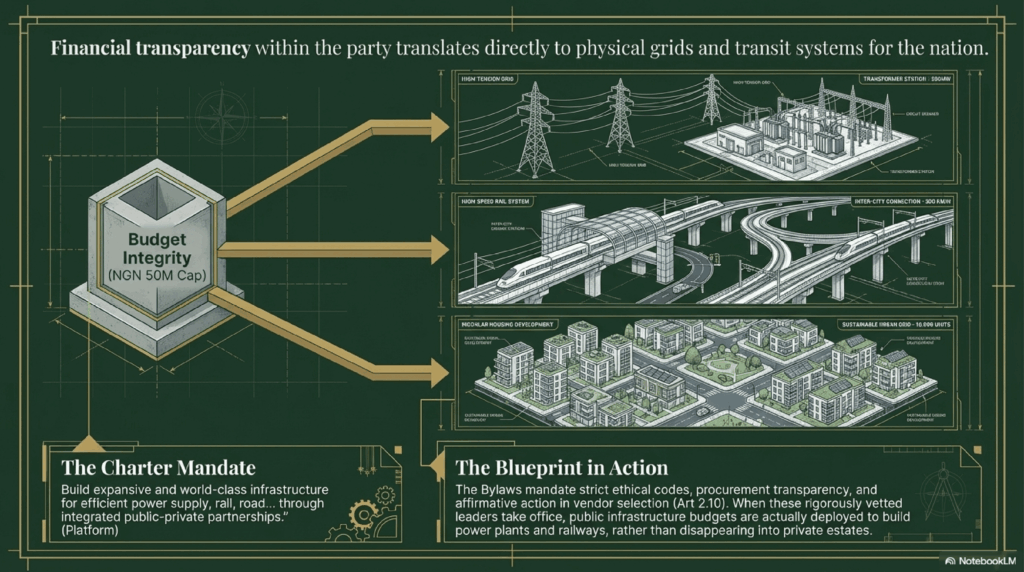
Through integrated public-private partnerships, the party intends to build world-class infrastructure in energy, rail, and healthcare. This isn’t just about building roads; it’s about creating an environment where the creative industries (film, music, fashion) and manufacturing can thrive globally through tech-driven productivity.
Institutionalized Inclusivity and "Zoning" Without Quotas
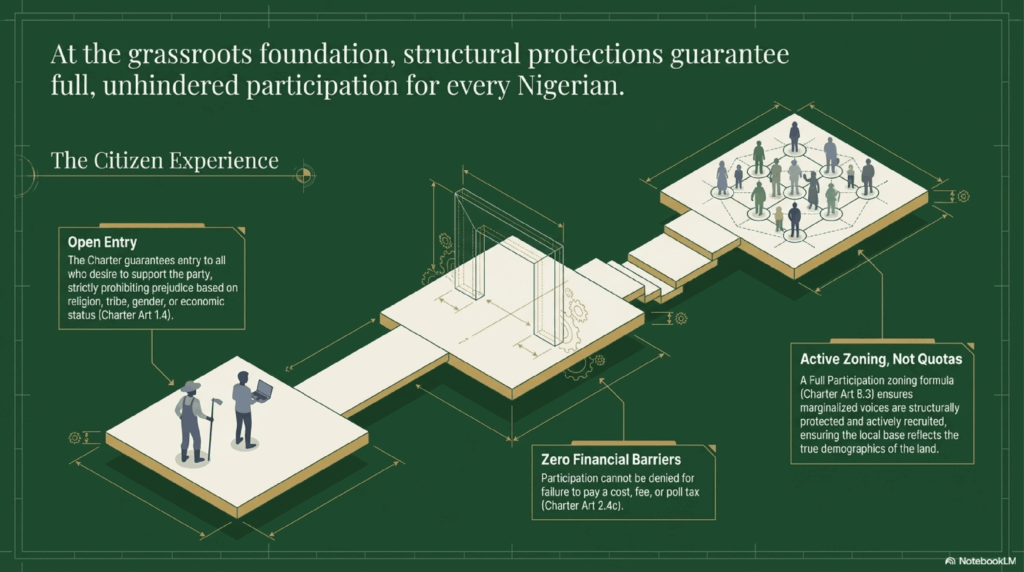
The 2024 proposals reject the tokenism of “mandatory quotas,” which Article Eight, Section 4 of the Charter explicitly prohibits. Instead, the framework introduces a more robust system of “zoning programs” designed to ensure the representation of women, youth, and low-income members.
This is not a suggestion; Article Nine, Section 15 requires the party to take “provable positive steps” to bring laws and internal structures into compliance with these representation goals. Furthermore, Section 11 of the Bylaws mandates that the party “equitably minimize economic factors” that prevent participation. By providing resources and outreach for low-to-moderate income “Children of the Land,” the party seeks to prove it is a truly “open party” where the “precious gift” of a citizen’s life is valued over their financial status.
The Independent Judiciary as a Reform Laboratory
Perhaps the most radical structural shift is the creation of the Disciplinary Committee, staffed by “respected legal professionals and retired judges.” This body functions as an internal “reform laboratory” for the Nigerian judiciary.
The Committee’s role is to ensure internal accountability, ensuring that even high-ranking officers are subject to the law. In a critical check-and-balance, Article Two, Section 10 specifies that the Committee’s decisions are submitted to the NEC for final approval, ensuring that the judicial branch remains integrated with the party’s legislative goals while maintaining independence from the executive (NWC). By modeling a culture of transparency and the rule of law within the party, the proposal aims to set a national standard that can eventually replace the “culture of corruption and cronyism” currently obstructing the administration of justice
.
.
Mapping the Structure to 21st-Century Outcomes

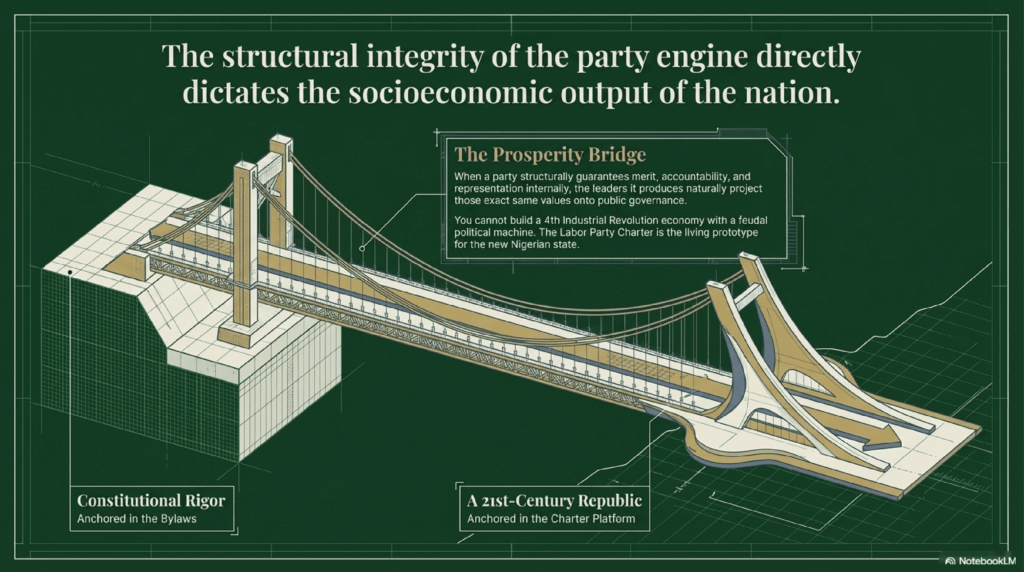
The draft 2024 Bylaws and Charter establish a direct link between technical rules and industrial success. A strategist views these rules as the “engine” for the following outcomes:
- Public Services & Civil Service: The NWC’s mandate for merit-based candidate recruitment (Article Two) ensures that those entering government are selected for competence rather than patronage, leading to an “honest and efficient civil service.”
- Energy and Electricity: Fueled by “entrepreneurial public sector governance” and the application of 4IR tech to infrastructure.
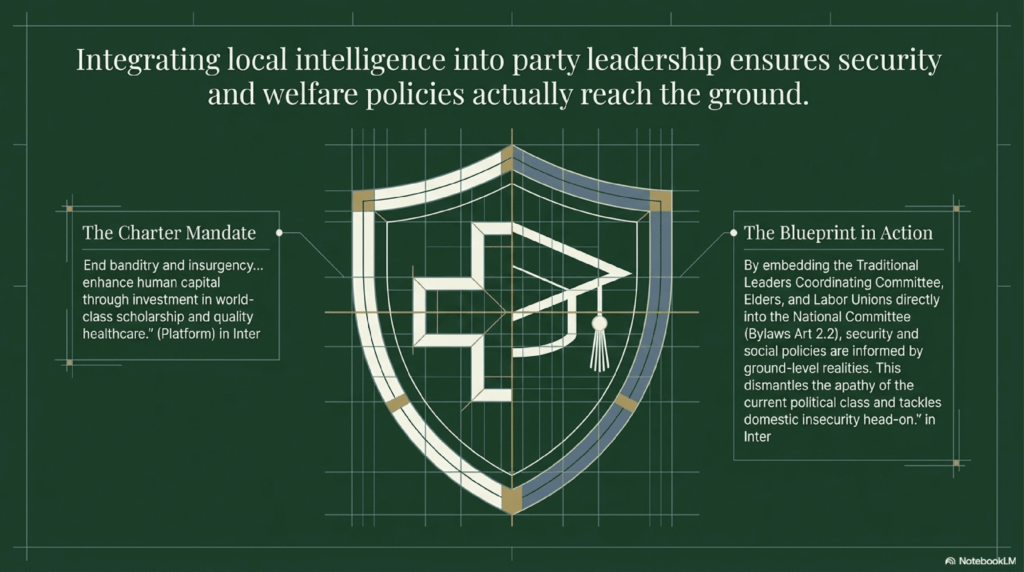
- Security: Replacing the reliance on “thugs” with a system driven by intelligence, community development, and ethno-religious dialogue, as outlined in the “Children of the Land” text.
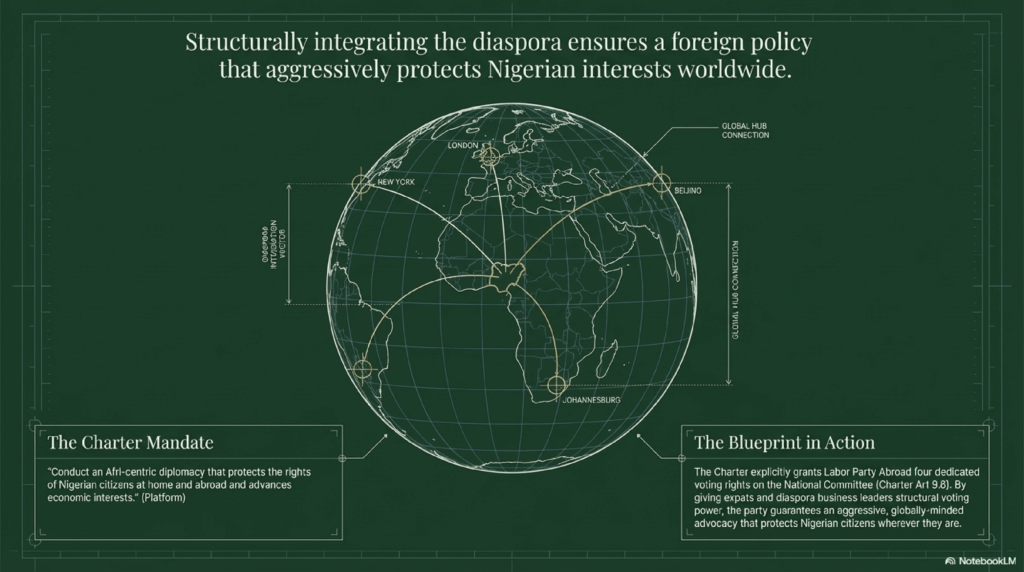
- Diplomacy: Implementing “Afri-centric diplomacy” to protect the rights of Nigerians at home and abroad, ensuring that foreign treaties and debts align with the “collective interest.”
A Legacy Beyond Elections
The 2024 proposals represent a “Political Revolution” rather than a mere change in leadership. They recognize that the current political class has shown a “barrage of calamity” and “brutality” toward the Nigerian people.
“There is one truth that has always been self-evident despite our collective amnesia: the lives of the Nigerian people are a gift bestowed by our God as an affirmation of the true value of each Child of the Land, and any political system whose character is thus illustrated, and class and actors associated, is unworthy of the privilege of leading the Nigerian people.”
For the 80% of voters who have withdrawn in despair, the question is now one of engagement. Are you ready to participate in a system built on specific, transparent, and enforceable rules? The “sacred duty” to remove the shackles of the old guard begins with the adoption of this blueprint—a transition from a feudal state to a just society where every Child of the Land can flourish.